Radical Behaviorism and Cultural Analysis by Kester Carrara
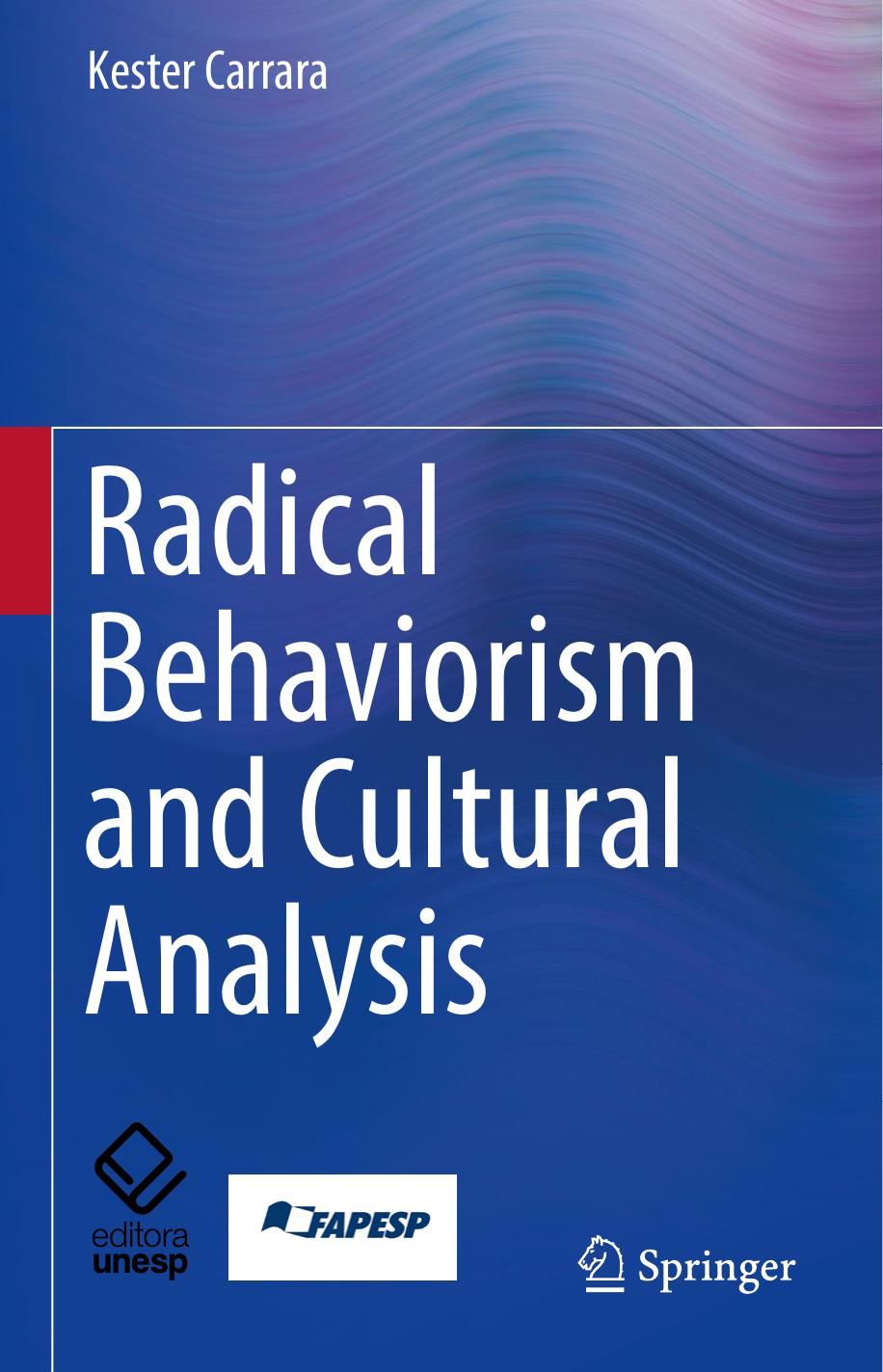
Author:Kester Carrara
Language: eng
Format: epub, pdf
Publisher: Springer International Publishing, Cham
However, does admitting that the physical and the psychic aspects “touch one another” imply that they interact with one another even though they are constituted of different substances? Or would it perhaps be equivalent to admitting that the psychological, in the sense employed here, is also physical and therefore there is a reduction of the former to the latter? Skinner was to unravel those questions in his own way in his formulation of Radical Behaviorism.
However that may be, the question of the dichotomy of appearance and reality made no sense to Ernst Mach, as he clearly stated in his work of 1905 (p. 22), and accordingly, physical and psychic events were of the same nature from which one can conclude that their nature is physical. That is a more precise statement than his affirmation that the physical [phenomena] “include” part of the psychic ones or that the latter are “mixed” with latter in sensations. Mach discards the idea of “essence” and states, like Skinner, that what is public and what is not apparent are happenings of the same nature (a step toward substance monism), thereby excluding the existence of internal structures created exclusively to explain events that are not susceptible to observation. Skinner also borrows the profile of economic description in science from Mach, one that parsimoniously reduces the creation of new concepts of new entities supposedly responsible for the dynamics of behavior in a way that lies beyond the interactions between organism and environment.
When Skinner addresses private events, especially covert behaviors, he handles the issue in the light of Mach’s understanding that the difference with them is a question of accessibility, not of their nature as such. In other words, in the final analysis, behaviors, whether public or covert, are of a physical nature. Obviously that does not mean that when observing structural, biological, and physical dimensions (e.g., inside a brain), one can exactly “see” the behaviors in them. One perceives a complex amalgam of biological structures but not the processes they are involved in, obviously. On the other hand, other private events, not necessarily behavioral, are also inaccessible to a second person. In that sense Skinner states that “my toothache is just as physical as the keys of my typewriter.” As can be seen, there are parts that are quite congruent between the two authors. It is possible to “read Skinner and find Mach” or “read Mach with a Skinnerean eye,” but that does not imply a true identity of concepts for the reasons that have already been presented.
In Elias’s (2012) interpretation, in the explanatory context for phenomena, Mach considered the importance of “the relations among physical facts that depend on circumstances external to the body and [also] on circumstances internal to the body which are the sensations .” He writes that:
Mach introduces the sensations concept to delimit what those psychic experiences would be. The sensations are not constituted from a differentiated nature. They are always given immediately. They are not anchored in the reality/appearance dichotomy. Furthermore, Mach
Download
Radical Behaviorism and Cultural Analysis by Kester Carrara.pdf
This site does not store any files on its server. We only index and link to content provided by other sites. Please contact the content providers to delete copyright contents if any and email us, we'll remove relevant links or contents immediately.
Rewire Your Anxious Brain by Catherine M. Pittman(18654)
Talking to Strangers by Malcolm Gladwell(13370)
The Art of Thinking Clearly by Rolf Dobelli(10489)
Mindhunter: Inside the FBI's Elite Serial Crime Unit by John E. Douglas & Mark Olshaker(9343)
Becoming Supernatural by Dr. Joe Dispenza(8217)
Change Your Questions, Change Your Life by Marilee Adams(7781)
Nudge - Improving Decisions about Health, Wealth, and Happiness by Thaler Sunstein(7706)
The Road Less Traveled by M. Scott Peck(7603)
The Lost Art of Listening by Michael P. Nichols(7506)
Mastermind: How to Think Like Sherlock Holmes by Maria Konnikova(7347)
Enlightenment Now: The Case for Reason, Science, Humanism, and Progress by Steven Pinker(7313)
Win Bigly by Scott Adams(7198)
The Way of Zen by Alan W. Watts(6614)
Daring Greatly by Brene Brown(6513)
Big Magic: Creative Living Beyond Fear by Elizabeth Gilbert(5771)
Grit by Angela Duckworth(5615)
Ego Is the Enemy by Ryan Holiday(5448)
Men In Love by Nancy Friday(5240)
The Laws of Human Nature by Robert Greene(5208)
